On a good year, seafood sourcing looks almost boring: seasons open, volumes land, grades hold, buyers negotiate, trucks roll. In a volatile year now increasingly the default boring becomes a luxury. Warm-water anomalies roll through a region, a cold-water species gets squeezed, a fishery closes or shifts, and the market scrambles: substitute species, different sizes, different origins, different lead times. The temptation in that scramble is predictable: loosen requirements, accept risk, and “solve” availability with paperwork gymnastics. The real test of a modern seafood company is what it does instead of how it adapts without quietly lowering the bar.
The Baseline Reality: Warming + Extremes + Moving Targets
Start with physics. The ocean is Earth’s main heat sink, absorbing about 90% of excess heat from planetary warming, which is why ocean warming is such a central driver of marine change.
Then come the spikes. The IPCC reports that marine heatwaves have doubled in frequency between 1982 and 2016 and have become longer-lasting, more intense, and more extensive. For fisheries and aquaculture, those are not abstract descriptors; they’re operational disruptions, growth rates change, oxygen dynamics shift, harmful algal bloom risks rise, and timing gets weird.
Finally, the map itself moves. A NOAA-backed PLOS ONE study modeled thermal habitat for 686 species on North American continental shelves and found projected distribution shifts were generally poleward; under a high-emissions scenario, many species shift more than 1,000 km. That kind of movement scrambles what “local,” “seasonal,” and even “reliable” means.
When “Volatile” Becomes Financial, Not Just Ecological
Volatility hits the balance sheet through one brutal mechanism: sudden scarcity. A dramatic example comes from Alaska snow crab. NOAA Fisheries reports the population experienced a decline of greater than 90% in 2018–2019, and notes that snow crab had supported one of the most valuable commercial fisheries in the Arctic, with an estimated annual ex-vessel value of $227 million. NOAA also warns Arctic conditions conducive to the stock may appear in only 8% of future years in the southeastern Bering Sea under further warming.
When supply collapses like that, pricing becomes reactive: buyers chase alternatives; inventories swing; menus and retail sets change; contracts get renegotiated. Multiply that by multiple species across multiple coasts and you get the sourcing environment many seafood businesses now live in.
And the stakes aren’t small. NOAA notes U.S. fisheries support more than 1.7 million jobs and $253 billion in economic activity every year, a reminder that climate-driven variability isn’t niche; it’s macroeconomic.
What Adaptation Looks Like When You Don’t Cut Corners
There are only so many levers a seafood company can pull in a crunch. The difference between “adaptation” and “corner-cutting” is whether the levers are structural (portfolio, infrastructure, verification) or procedural (waivers, exceptions, “we’ll fix it later”).
Below are the structural moves that show up again and again in resilient sourcing programs and how Pacific Seafood describes some of them in its own reporting.
1) Build a Portfolio That Can Flex (Species, Geographies, Production Methods)
If climate change pushes species around, a single-species or single-region strategy becomes fragile. One resilience tactic is simply breadth: more products, more certifications, more options when substitutions are needed.
Pacific Seafood reports it offers 73 certified sustainable fish species across programs including MSC, RFM, ASC, and BAP an explicit signal of a portfolio approach paired with third-party verification.
A second hedge is mixing wild-caught and farmed supply. Aquaculture isn’t immune to climate risk, but it can diversify timing and volume. Pacific Seafood highlights certified aquaculture practices and monitoring, including 24-hour underwater video surveillance for its steelhead operations and reporting no net pen escapes since purchasing the operation in 2008 a detail that speaks to risk management and containment discipline.
2) Invest in Distribution Capacity so “Where It Lands” Isn’t “Where It Must Be Sold”
When availability becomes patchy, logistics becomes strategy. If you can move product efficiently across regions, you can smooth localized shocks: a shortfall in one area doesn’t automatically mean an empty case.
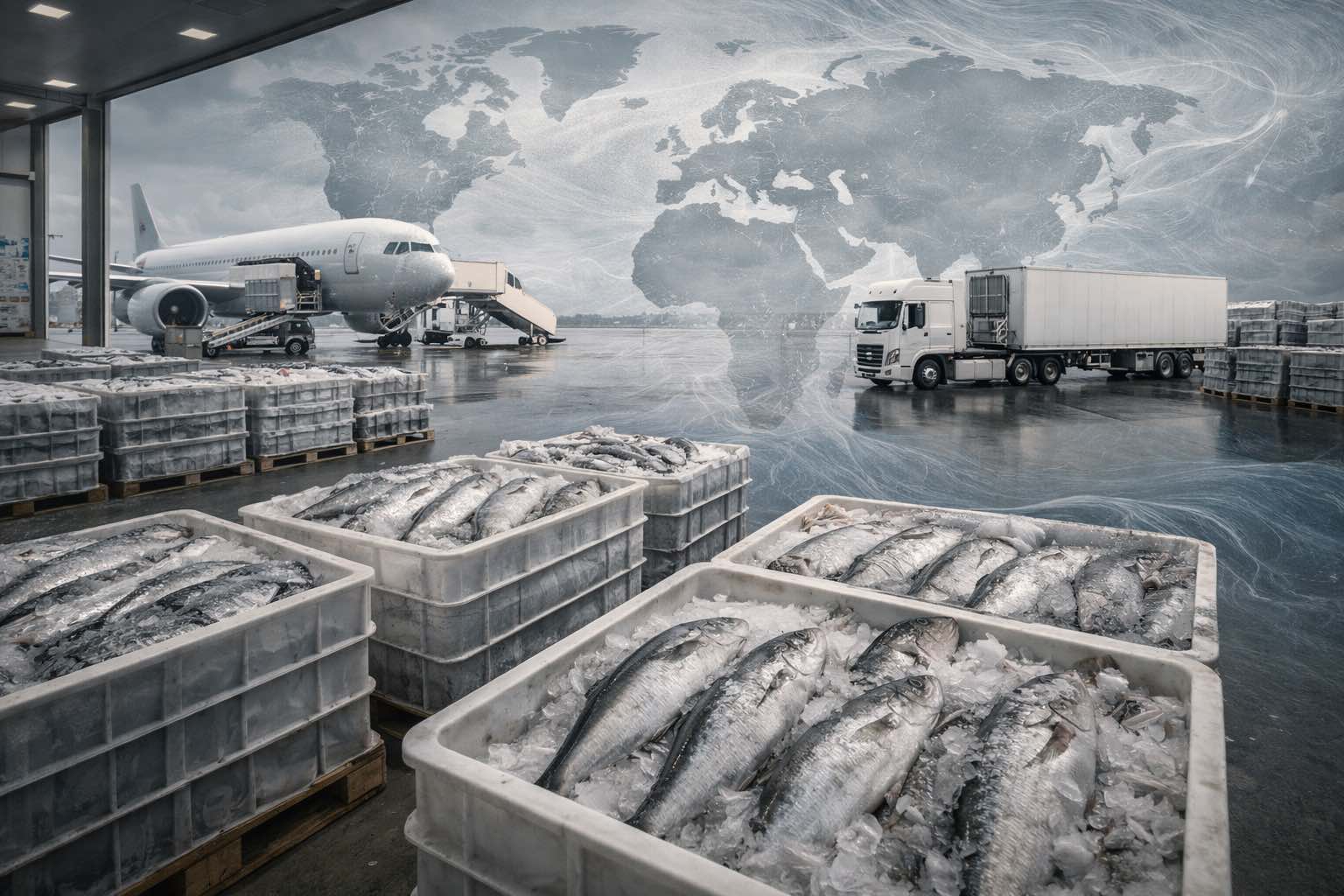
Pacific Seafood’s CSR report describes a distribution network spanning eight distribution facilities, plus a dedicated transportation team and an air freight division. That kind of network is essentially a volatility buffer especially when seasons, weather, and regional closures make supply uneven.
3) Make “Verification” the Choke Point Not the Thing That Gets Waived
In volatile markets, the most dangerous sentence in procurement is: “We’ll take it and sort it out later.” Food safety and legality don’t become less important because supply is tight. If anything, they become more important, because bad actors also exploit chaos.
Pacific Seafood describes a supplier program that checks prospective partners for food safety rejections/alerts/recalls, verifies suppliers are HACCP certified weekly, and requires shipments to include a Positive Release Form demonstrating required testing (varying by species) plus traceability documentation like date coding and, when relevant, SIMP (Seafood Import Monitoring Program) documentation.
That structure matters because it creates a non-negotiable gate: if a shipment can’t clear the documentation and testing threshold, it doesn’t enter the system no matter how badly the market wants the product.
4) Treat Receiving and Qa As the Front Line of Resilience
“Quality is won or lost at receiving” is a cliché because it’s true. And when volatility increases, receiving gets harder: more substitutions, more new suppliers, more unusual sizes/forms, more complicated paperwork.
Pacific Seafood reports routine species ID and lab testing including regular DNA and net weight tests, a minimum of 120 frozen receiving checks annually, and a minimum of 12 full product inspections at distribution sites annually. Those are the kinds of controls that keep substitution from turning into mislabeling and keep urgency from turning into error.
The Uncomfortable Part: Saying “No” When the Market Says “Yes”
Volatility produces pressure, and pressure produces rationalizations. A climate-driven shortfall can quickly turn into a moral hazard: buyers accept incomplete documentation, tolerate weaker chain-of-custody, or choose suppliers with lower transparency because “everyone else is doing it.”
The more disciplined approach flips the script. Instead of asking, “How do we source something?” the question becomes:
- What can we source while preserving safety, legality, and chain-of-custody?
- What substitutions can we make without misleading customers?
- What product forms (fresh/frozen/value-added) preserve quality and reduce waste under new conditions?
This is where third-party standards and internal controls act like a conscience you can audit. If your system requires weekly HACCP verification, positive release testing, and traceability documentation for each shipment, the “easy yes” becomes operationally difficult and that’s the point.
What a “No-Corners-Cut” Playbook Can Include (Beyond Any One Company)
Even with strong internal programs, industry-wide resilience increasingly depends on coordination:
- Better forecasts and scenario planning: pairing ocean/climate indicators and fishery science with procurement planning (species shift modeling like the 686-species thermal habitat work is exactly the type of science businesses can translate into risk maps).
- Adaptive management and transparency: when stocks shift, management systems need to keep pace otherwise legality and sustainability claims get muddy fast.
- Cold-chain and inventory strategy: more freezing at peak quality, smarter routing, and distribution flexibility to reduce spoilage when timings become unpredictable (this is where “eight distribution facilities + transportation + air freight” reads as resilience infrastructure, not just scale).
- Supplier development, not supplier shopping: in a tight market, long-term partnerships with clear standards reduce the need to gamble on unknown sources.
- Human rights due diligence: supply chain volatility can increase labor risk; strong screening and documentation requirements help prevent “cheap” supply from hiding unacceptable practices.
The Takeaway
Climate variability is changing seafood sourcing from a seasonal planning exercise into a continuous risk management discipline where the winners won’t be the companies that can say “yes” the fastest, but the ones that can say “yes” without weakening safety, legality, traceability, or sustainability even when the ocean, and the market, refuse to cooperate.