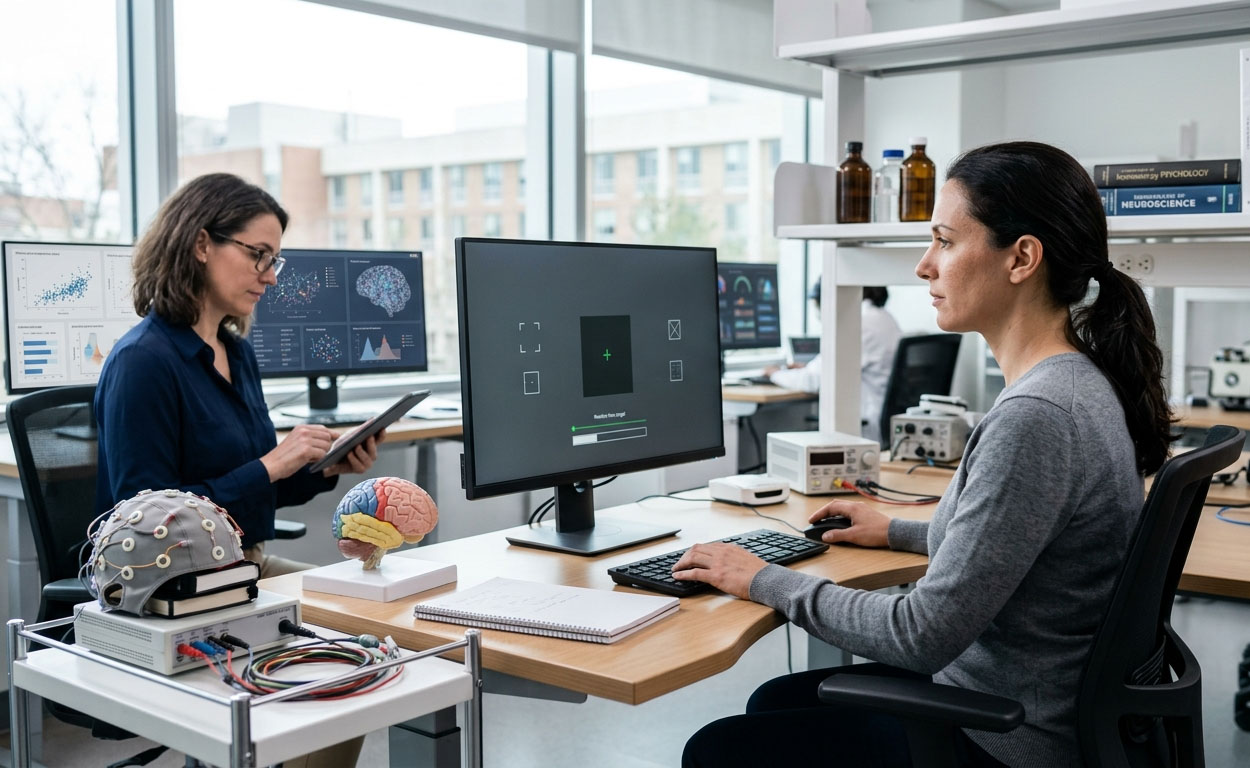
Our brains handle thousands of decisions every day, from recognizing faces to reacting to unexpected events. Scientists have spent decades studying these mental processes, creating standardized ways to measure how people pay attention, remember information, and respond to changing situations. Modern online cognitive tests make many of these research-inspired assessments available to anyone with an internet connection, offering a practical way to observe specific mental abilities without claiming to measure overall intelligence or health.
Quick Summary
- Cognitive tests measure individual mental skills such as attention, memory, reaction time, and processing speed.
- Benchmarks compare an individual’s performance with broader groups under similar conditions.
- These assessments are valuable for research, education, and personal curiosity, but they are not medical or intelligence exams.
- Results are most meaningful when viewed over time rather than from a single attempt.
Cognitive science combines psychology, neuroscience, statistics, and computer science to understand how the human mind processes information. Careful measurement allows researchers to identify patterns, compare populations, and evaluate how different factors such as age, sleep, learning, or practice influence mental performance. Understanding data literacy and variability also helps readers interpret benchmark scores without drawing misleading conclusions.
What Exactly Is Cognitive Testing?
Cognitive testing refers to structured tasks designed to evaluate one or more mental abilities under controlled conditions. Unlike traditional school exams that measure learned knowledge, cognitive assessments focus on how efficiently the brain performs specific functions.
Researchers usually separate cognition into several major domains, including attention, working memory, long-term memory, perception, processing speed, and executive function. Each area can be measured using carefully designed tasks that minimize outside influences and produce repeatable results.
Many laboratory assessments have inspired simplified digital versions. For example, a visual memory test challenges participants to remember spatial patterns for short periods. While simplified, such exercises reflect genuine scientific principles that psychologists have studied for many years.
Why Researchers Measure Individual Mental Skills
The brain performs many operations simultaneously. Someone may react quickly but struggle to remember sequences. Another person may have excellent memory but slower decision-making speed. Measuring separate abilities helps researchers avoid oversimplified conclusions.
Instead of assigning one overall score for “brain performance,” scientists often evaluate different cognitive systems independently. This approach creates a clearer picture of strengths and weaknesses while reducing the chance of misinterpreting results.
| Cognitive Ability | What It Measures | Typical Assessment |
|---|---|---|
| Reaction Time | Speed of responding to a stimulus | Click after a visual signal appears |
| Attention | Ability to stay focused | Target detection exercises |
| Working Memory | Holding information briefly while using it | Number or pattern recall |
| Processing Speed | Efficiency of mental operations | Timed symbol matching tasks |
How Benchmarks Make Scores More Meaningful
A raw score rarely tells the full story. Finishing a task in 280 milliseconds may sound fast, but without comparison, the number has little meaning. Benchmarks solve this problem by comparing results against larger groups of participants who completed the same assessment under similar conditions.
These comparisons allow researchers to identify average performance, typical variation, and unusual results. Benchmarks also reveal trends across different age groups, occupations, education levels, or other populations.
Statistical analysis plays an important role here. Rather than treating every difference as meaningful, researchers examine whether observed differences exceed normal variation expected within large datasets.
Reaction Time Is More Than Fast Reflexes
Reaction time is among the most recognized cognitive measurements because it is simple to understand and relatively easy to measure accurately. A participant waits for a stimulus and responds as quickly as possible.
Despite its apparent simplicity, reaction time depends on several stages working together. The eyes detect a visual change, the brain processes the information, a decision is made, and muscles carry out the response. Each stage contributes to the final measurement.
Researchers use reaction time to investigate learning, fatigue, aging, neurological conditions, and human performance across many settings. Athletes, drivers, gamers, and pilots all rely on quick responses, making reaction time an interesting area of applied cognitive research.
Memory Testing Goes Beyond Memorization
Memory consists of multiple systems rather than a single storage unit. Scientists distinguish between sensory memory, short-term memory, working memory, and long-term memory because each serves different purposes.
Working memory has received considerable attention because it supports everyday reasoning and problem solving. It allows people to hold information temporarily while performing another task, such as calculating expenses mentally or following spoken directions.
Visual memory assessments examine how effectively individuals remember locations, patterns, or images after brief exposure. These tasks provide useful insight into one specific aspect of memory without attempting to summarize every cognitive ability.
Attention Helps Filter an Overloaded World
Humans constantly receive far more information than the brain can consciously process. Attention acts as a filtering system, selecting relevant information while suppressing distractions.
Scientists study attention using tasks that require participants to focus over extended periods or rapidly identify important targets among irrelevant information. These assessments help researchers understand concentration, distraction, and mental workload.
Many everyday activities depend on sustained attention, including driving, reading, studying, programming, and monitoring equipment. Small declines in focus may influence performance long before a person notices becoming distracted.
Processing Speed Supports Everyday Thinking
Processing speed describes how efficiently the brain completes mental operations. It differs from reaction time because it often involves recognizing patterns, making decisions, and handling increasingly complex information rather than responding to a single signal.
Faster processing speed can improve efficiency during many daily activities. Reading unfamiliar material, solving calculations, recognizing visual information, and following conversations all depend partly on how rapidly the brain processes incoming information.
Researchers continue examining how processing speed changes across the lifespan, helping build a clearer understanding of normal cognitive development and healthy aging.
Factors That Influence Test Results
Performance varies naturally from day to day. A single score should never be treated as a permanent measure of someone’s abilities because many temporary influences affect cognition.
Some common factors include:
- Sleep quality the previous night.
- Stress and emotional state.
- Caffeine consumption.
- Physical fatigue.
- Practice and familiarity with the task.
- Environmental distractions.
- Device differences such as screen refresh rates or input lag.
Researchers attempt to control these variables in laboratory settings. Online assessments cannot eliminate every influence, which is another reason repeated testing often provides more useful information than a single attempt.
Looking at Trends Instead of One Score
Scientists usually value repeated measurements more than isolated results. Tracking performance over weeks or months helps identify consistent patterns while reducing the influence of temporary fluctuations.
This same principle appears in many areas of data analysis. Just as economists examine long-term trends rather than one day’s market activity, cognitive researchers look for sustained changes instead of isolated highs or lows. Similar thinking appears in discussions about data entry accuracy and speed, where consistency often matters more than a single fast performance.
How Scientists Build Reliable Cognitive Tests
Developing a useful assessment requires much more than creating interesting puzzles. Researchers follow rigorous methods to improve consistency and reduce bias.
- Define the mental ability the test is intended to measure.
- Create standardized tasks with identical instructions for every participant.
- Collect data from large groups to establish benchmark distributions.
- Evaluate reliability by checking whether repeated testing produces reasonably stable results.
- Study validity to confirm that the assessment measures its intended cognitive ability.
These steps allow researchers to interpret results with greater confidence while acknowledging the natural variability found in human performance.
Separating Cognitive Performance From Intelligence
One of the biggest misconceptions surrounding cognitive assessments is the belief that they measure overall intelligence. Most do not.
A reaction time task measures response speed. A memory exercise measures one aspect of remembering information. Attention assessments examine concentration under particular conditions. None of these individually capture creativity, emotional understanding, practical reasoning, accumulated knowledge, or countless other characteristics that shape human capability.
The broader scientific field of cognitive psychology recognizes cognition as a collection of interacting processes rather than a single universal ability.
Building Better Understanding Through Measurement
Cognitive testing continues to provide valuable insight into how people perceive, remember, focus, and respond to the world around them. Carefully designed benchmarks allow researchers to compare performance fairly while recognizing that every individual shows natural variation over time.
Digital assessments have made many research-inspired tasks widely accessible, allowing curious individuals to experience the kinds of measurements used in cognitive science. Used appropriately, these tests offer an informative snapshot of specific mental skills rather than a complete evaluation of intelligence or health. Understanding what the numbers represent, and what they do not, is the key to interpreting cognitive benchmarks responsibly.